Pages

Friday, November 7, 2014

Thursday, November 6, 2014

Midterm


            Graciela Iturbide
The name of the artist who I assigned to is Graciela Iturbide. She is a Mexican artist. She was oldest of thirteen kids. In the video I saw that her artwork was all about photography. Although she was a photographer she did not learn about photography, but about life. She tried to photograph that usually not seen. She worked with black and white photography and it was her way, which expressed herself very well. Her photographs are Catholic related. She was very careful to take photograph and her material was real life. Iturbide works as an anthropologist does, living among a community, befriending its women and children, and sharing in their daily chores and annual festivities. She enters the sacred and intimate world of cemeteries, healings, marketplaces, and homes. She was interested to know the world. She says, “Lies in what her eyes see and what her heart feels—what moves her and touches her.”  She took self portrait too. At the beginning she used to photograph the abstract objects.
 She received special permission to photograph the Kahlo belongings that remain at the Blue House. The images she captured represented the Kahlo's daily life such as leg brace, old dishes and so on. One especially interesting item of Iturbide was Kahlo's hospital gown, covered in a striking combination of paint and blood. She start landscape photograph when she came US. She saw empty streets, no human, which is different from Mexico.  She has produced studies of landscapes and culture in India, Italy, and the Unites States, but her principal concern has been the exploration and investigation of Mexico of her own cultural environment through black-and-white photographs of landscapes and their inhabitants, abstract compositions, and self-portraits.  Her images of Mexico's indigenous people of the Zapotec, Mixtec, and Seri—are poignant studies of lives within the bounds of traditional ways of life, now confronted by the contemporary world. Turning the camera on herself, Iturbide reveals the influence of her mentor Manuel Álvarez Bravo in self-portraits that transform her quotidian self and play with formal innovation and attention to detail. She has also documented “cholo” culture in the White Fence barrio of East Los Angeles and migrants at the San Diego/Tijuana border, illuminating the bleak realities of her subjects' search for the American Dream. Her prints are etchings of exquisite tonal beauty, texture, and detail. She is really a talent artist. She collected different parts of life and presented to the world by black and white color. It’s really amazing. 

Midterm


Marina Abramović - The Artist Is Present - Viennale 2012.jpg

Hello bloggers!
Pictured above is one of the great artists in history. Her name is Marina Abramovic, and she is of Yugoslavian descent. Her parents were both military figures, and proud members of the National Communist Party. Abramovic was born into a family that was full of intense contradictions; whether it be from religion, or politics. These contradictions, she explains, provided her with "an unbeatable combination to grow as an artist." Even as a child, Marina displayed incredible ability and talent. She was only 12 years old when she had her first exhibition, which was comprised of mostly drawings and paintings. What her parents, her friends, and even herself didn't know at that time, was just how far her artistic journey would take her. 

Pictured above is perhaps the greatest performance artist in history. Her name is Marina Abramovic, and she has a new fan for life. In her early 20's Marina had a "spiritual revelation", which would shape her entire career and future as an artist. One day, while laying on her back with her eyes to the sky, she noticed the effect that a jet plane flying above had on cloud vapors. Excited and inspired, the young Marina came to a profound realization. She could use anything that her heart desired to create art; water, fire, air, even her very own body! In that moment she understood that it was completely ridiculous to go back to a studio to create something that was two-dimensional. Marina had the entire world at her disposal, and just like that her days of painting were over.

Her early performance pieces incorporated sound into visualizations. It was also at this point that she began to test the limitations of the human body. With a show titled Rhythm 10, Marina used twenty knives and two tape recorders in a performance that attempted to merge past and present. The crowd was overjoyed, and Marina was so pleased by their approval that she decided then and there to never go back to traditional art. Throughout the 1970's her performances became quite violent, and extremely physical. The constant testing of her physical limitations encouraged her to become interested in other areas, like the mental state of peace; achieving it, then extending it. This is an ongoing mission for Marina, as we can see from this image taken during a performance piece at the Museum of Modern Art entitled The Artist is Present:
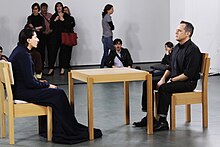

Lately, like the photo shown above illustrates, Marina has been focusing on longer-duration pieces, including ones in which she never leaves the performance area. One thing is abundantly clear, she is not even close to being finished pushing herself as a performer. However, due to her age, Marina has become somewhat concerned about her legacy as an artist. It has been a strenuous task convincing the masses that what she does is in fact art. Personally, I find that her insecurity actually motivates me as an artist. The way that I see it, if Marina Abramovic- the grandmother of performance art, still feels the need to convince the world of her legitimacy, then I most certainly have a lot of work to do!

There is one specific reason why I chose to structure my first two paragraphs the way that I did, and that is because Marina deserves to be classified as an artist first, and a performance artist second.

I found Marina's work to be extraordinary. Full Disclosure: I was disappointed when I initially saw my assignment. I knew very little about performance art, and even less about the artists themselves. That has eternally changed! I thoroughly enjoyed diving into Marina's world. Her artistic process is remarkable and revolutionary. In fact, I was halfway done watching before I suddenly realized that the profile video itself WAS a performance piece. In closing, I would like to leave you with a quote from the artist herself: 

"An artist should look deep within themselves for inspiration. The deeper they look, the more universal they become. The artist is universe"


Midterm


The artist Tabaimo is a Japanese artist who tries to tackle big projects to deliver a strong message. In the video segment that I watched, she was showing a illustration made in an entire building. Where she gets her ideas from seemed to be from a common place, but at the same time something that couldn't be replicated due to it being her own thoughts. Tabaimo is inspired by her own personal experiences, as well as societal malpractices. Examples of this is a representation is when she describes the idea of a baby going down the toilet in one of her illustrations as her friend's baby who she gave up for adoption right after birth. As mentioned before, the art demonstrated in the segment only contained illustrations that she has created. These creations use many different images, or animations, to show or symbolize a theme. As well as the animations, her pieces also incorporate music to create more of an atmosphere and better tell the story of her work. With having the illustrations surrounding the room from wall to wall in most cases, having a visual effect and audio effect on the viewer drastically changes the way they will interpret the piece. Tabaimo even states that her job is to deliver 50% of the message and the audience is supposed to make up and receive that remaining 50%. The way she creates these pieces is very, in my opinion, common as well. She first draws out the stages the animation is going to take by drawing each image. After, on the computer, she fills it in with color and transforms the static images into an animation. Thus, the only real materials that she uses are pencil and paper, the computer, and the building she's places the installation in. As different it may be compared to many of the more common ways to show art, I feel like Tabaimo is successful in expressing her idea in this way. I was surprised that installations could be made in such a large scale. I was amazed when I heard her say that she used the whole building to create her piece of art. After watching the video, I felt like a new way of thinking on how art can be made developed. If an average person were to be told to create a piece of art, chance are that they would make a drawing or a painting, or even a sculpture of common items. This has now made me think of the many ways art can be created.


Midterm


    The artist I was assigned to talk about is Catherine Opie. Catherine Opie is an american artist. Her work is based on documentary photography. She was born in 1961 in Sandusky, Ohio and then later on moved to California when she was a teenager. Catherine talks about how she was only interested in the architecture of American cities. She would "empty" out these cities and just take photographs of building and structures by itself. You would not see any people or animals inside of these portraits. After she started to photograph in the streets again though, she explains how she was brought back to the roots go street photography. She also talks about seducing the viewer in a different way to pictures besides just relying on the body and color. She realized that it was time to stop emptying out cities and start documenting notions in time. Notions of American landscape in terms of identity. Catherine tells about how she photographed Lake Eerie in Ohio but one of the things she did not like was the waves. There are photographs that she takes of the same thing but just in different seasons. One of her photographs she talked about is one that was going to to be placed in a hospital. She wanted it to be just right, to be life changing whether you were in the hospital receiving good news or bad news. I found what she said next extremely interesting. She said wanted people to look at her picture and for it to make them feel like an escape for them. This was how she got through hard and emotional time during her life. As you can see in the above photographs the first one could be considered an empty portrait because all it is, is a mountain, trees, and water. The second photograph though is more when she changed her view and started photographing notions in time. This photograph was from the Inaugural series in 2009. When choosing her photographs she lines then all up on the wall so she can compare them and see which aspects she likes from them the most. She explains that it's more than just getting a nice shot of something that makes a picture good. The light and image needs to be balanced to really have a portrait.  You can see the people standing up watching the screen to see the president. This is capturing a specific moment in time. The materials she basically uses is her camera and paper she prints the pictures on. I think that her work is successful and complete exploration in her ideas. You can tell by her photography, it speaks for itself. She captures a time and events in some of here photographs such as the Inaugural photograph and then captures a soothing more comforting photo where you can envision yourself in such as the mouton picture or the picture of the man with the surfboard at the beach. This video definitely made me think differently about the way artists work. It made me think about what exactly the artist is trying to explain or what the reason is for creating that piece of art they made. What story is it trying to tell? Why did they pick this specific thing? Is the art supposed to have a deeper meaning? Is it supposed to be soothing and provide a way of escape like some of Catherine's works do? These are all questions that I will ask myself now when looking art different types of art. The only thing I did find surprising is the pictures of the emptied out cities. I found it surprising because sometimes pictures like that can be bland or boring but the pictures that Catherine took gave you a look at the architecture and the emphasis that was put in to build certain buildings. Along with that it also left me with a sense of intrigue. It had me wonder about what was actually happening at that place in that specific time that the picture was taken. There are no people in the pictures to help suggest what's taking place, you are only left with your mind to help you imagine what could be taking place in that city in the photo.


Midterm:
           
Kimsooja is a performance artist, in the video she speaks about a video she made called " A Needle Woman" she starts the video by showing an image of her laying on a large rock she is facing the nature her back towards the camera and the lens represents the human watching her, she makes her artwork from the viewers perspective. In the video Kimsoojaa speaks about her process while thinking of doing this specific video, she was thinking of doing a walking performance. While walking through Tokyo in 1999 she found herself in a large crowd of people and she decided to walking because she couldn't walk anymore, she used her body as a symbolic needle into the earth representing the energy that she had at the time. The people walking all around her are used as slow motion for the video and they represent a form of needles going thru her body. The entire video is done while her back to the camera never revealing the artist's identity I think this video was made this way because it shows how one can essentially stop living but that the world continues to move forward with or without you. The materials that the artist is using for her art are her body and the environment. There are three different perspectives in this art they are the camera lens, her eyes, and the people in front and around her. The artist is interested in representational art and the way this is showed in her work is by never showing her identity she represents live and it is up to the viewer to make their own conclusion about the art in front of them. In the video the artist states that her work is always in transition/ in process and that her work is never really finalized. There is also another video of her on top of a moving truck with representing her life as she explains that her father a military man was forced to constantly move with the family, she states that it is a part of their history. I feel that Kimsooja is successful in her work because instead of using material around her, her work is focused on making the person the work of art not a tangible materialistic object, this made me think differently about the way artist work because I never thought about someone as a work of art I just though of art as a painting or a sculpture now things that are in motion like people. Something that surpised me about this artist and her work is that the way she makes her art can be interpreted by many people ant they would see it differently, it is not like looking at a paining where for the most part you know what is happening.

midterm


In the process of making the art 

End result, how it looks it just a small of part of the whole art

For my midterm I got on Thomas Hirschhorn in “Investigation” and that art is base on creating a “New monument” he made so many monuments in past but he call this as a new because it’s new in case of location. All the artist try to make their art at a place where everyone can see and praise about it but Thomas Hirschhorn made it in front the residents of a Bronx public housing, his idea and interest in this art is to create space where people can make some memories in their life and he is focusing on the art form of To give tangible form to feelings and ideas and also To refresh our vision and see the world in a new way, I said it because he brings back the thinking ideas of famous people called Antonio Gramsci and well as some other such as Malcolm X.  Hirscchorn made some post banner and hang it everywhere and also write it in wall and other space. I just got some interesting quote of Antonio Gramsci from his prison notebook “Quality should be attributed to human beings,  Not to things. (Antonio Gramci). Thomas Hirschhorn is saying that everyone has understanding of art and “what is separating us is smaller than unifying in order to unify one really have to take something who goes beyond and this is art to me” the process of making this art is that he asked for helps from the residence of forest house and form a group of 15 people and they work as term and he called it co existence. The materials he used to form this art are the daily use things such as tape, cardboard and wood. By looking at the difference of the place from the beginning and the after the monument is formed it’s totally changed it became so popular and useful. The art is successful because it really makes people think in a new way and they share different kind of stories and as the audience in the video said that they learn lots. The activities that happens over there are live Radio, art class, food, Internet café, sport and everyone talk at a time (this is kind of funny). Thomas Hirschhorn use the term ‘Energy Yes” Quality NO”. The common non-artist people did the work and it came out as the very professional artwork where everyone can visit for free and enjoy. It is surprising that very common and simple every material can form such a great artwork and at place like that. So I came to know that art could be anything and at everywhere, it really don’t have to be at museum and nice place. Art can be form on different types.


Midterm


     The artist that I was given is named Lynda Benglis. Lynda Benglis makes installation and sculptures that are dimensional. Her sculptures were made with liquids that turned to soild forms. Benglis considers herself as a painter because she was always interested and enjoyed using painting materials. She uses materials painters are known to use such as polyurethane, foam, and wire mesh. She also has considered herself as a painter because she doesn't use glue as an artist. Benglis says she choose to be a painter because she likes the idea of the materials forming their form and the spaces it creates. She's very interested on using her movement of her hands and body to make her sculptures. Benglis uses a bucket or can filled with paint and she kind of just uses her body movement, like dancing to a rhythm as she states in the video to make her sculptures. Benglis also shows an interest in the idea of having a perspective on gravity and on reading the form gravity forms. In the video she compares one of her sculptures to a waterfall that has been frozen, which is her view on gravity like what would a waterfall look like if it just froze while flowing. She also worked with the idea of knots in a couple of her sculptures. In the video she has a sculpture and she made a two headed snake and the snakes body is made with knots. She states that knots are like a explosion of energy or a meaning of beginning of new life. With wire mesh she made some sculptures with knots, she says it was way she also created space by tieing the wire mesh into knots. With cast polyurethane she liked how it looked like ice or glass or frozen water. She made a sculpture and was glad that people were given the illusion that the material was glass and out of that she wanted the sculpture to be a fountain. I think Benglis sculptures are great and definitely covers her interests on using movement and gravity as a way of creating space and sculptures. What I found to be interesting was using your own body movement to create art, I never thought of being able to make art by the movement for your body or hands as Benglis did. What also caught my attention was her perspective on gravity. She made sculptures out of her thought on how gravity creates a form when or if something froze.